

Grand Ages: Rome
 08. Nov, 2010
  5 Comments
Grand Ages: Rome
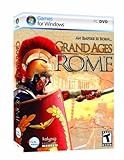
- Grand Ages: Rome lets you gain power and influence over one of the greatest civilizations in history
- Advanced Battle System with detailed RTS combat with 18 military units
- Intense online multiplayer modes for competitive and cooperative play
- Non-linear storyline features over 40 missions
- Use flow resources to create an intricate economic system
Raise massive armies and embark on epic campaigns to expand the Empire and take control of the known world! Engage in grand-scale city building and create magnificent cities with creativity and control like never before. Intuitive controls make it easy to launch bone-crushing combat missions and manage every aspect of your thriving civilization. After decades in exile, your family name has been all but forgotten in Rome. But the departure of the tyrant Sulla has changed everything, and Rome stan
Rating:  (out of 15 reviews)

List Price: $ 19.99
Price: $ 2.39


Review by Lisa Shea for Grand Ages: Rome
Rating:
A Roman city-building sim in the vein of such classics as the Caesar series, Grand Ages: Rome has an intriguing premise and workable gameplay, but falls short in other areas.
Grand Ages is a game where you build an ancient Roman city and must keep it operational and successful against adversities and invaders. Providing citizens with food, entertainment, and religious fulfillment are as important as keeping your resources in order. Unlike Caesar, which relied on a road-based infrastructure (everyone has to walk on roads, things travel to and from buildings), Grand Ages uses areas of effect. In short, each building has a circle around it showing the buildings that it will influence. For example, if you put down an apartment complex, the inhabitants of that apartment will only staff a building within the circle. A food storehouse will only feed people within its area of effect, and so on. Some buildings produce global resources that are added to an overall stockpile that are then used by other buildings. A brickmaker produces 20 bricks, while the average house uses up one unit of bricks. Therefore, based on upkeep and the expanding size of your city, you have to maintain a balance between population and facilities.
The problem with these areas-of-effect is that it’s remarkably easy, given their shape, for buildings to get stuck with partial coverage. The fact that you can only build a short distance away from your current settlement prevents you from pre-planning where you’ll need entertainment buildings or temples before you start building houses – and the effects of not having entertainment are immediate once those houses are plopped down, as the many riots my cities went through can attest to. In fact, the development of the city is often the biggest hindrance to the city. The nature of the areas-of-effect encourages growth (by spreading resources around the map) but also demands close-in urbanization (by requiring you to cluster your houses around facilities). Because of the fact that you can only build near your established buildings, it’s often the case that you have to stretch out your town to get in a position to reach the very resources you need to build your town up in the first place. It’s not a bad system, per se, it’s just frustrating at times.
The combat in the game is simple but effective. There are many units available – regular units like archers, cavalry, and infantry, as well as a wide variety of mercenaries. The middle class – the Equites – provides your regular soldiers, and when properly supplied with weapons and armor can be called into action. Mercenaries are hired for money and for certain other requirements (such as wine and entertainment). All units consist of roughly 30 soldiers. Units can gain experience through fighting, and can train when not engaged in combat to level themselves up. Some maps have barbarian villages spread around; subduing these (simply by engaging the guards they send out, then walking in once they’re all dead) rewards you with additional resources provided by the conquered villagers. In addition to offense, you can also build walls and towers to defend your city from attack.
One of the game’s main features is that your profiles are represented by characters. A character is a member of one of five families, each with different strengths (one family is better with military matters, one is better with mercantile affairs, and so on). By completing campaign missions and bonus objectives, you unlock new abilities and bonuses that affect all the games you play with that characters – campaign, free build, or multiplayer. For this reason, it feels that the entire game is interconnected – there’s no way to just play. Even the free build mode, rather than providing you with open maps and settings, is only about 15 maps with predetermined start locations and resources. This means that it’s difficult to just jump into the action and make a nice city.
The game’s graphics are very good; the cities look beautiful, with paved stones and detailed buildings. Citizens walk around the city to their jobs, and always look busy if you ever care to zoom in and examine them. If it rains, citizens will cover their heads and run indoors. There are a lot of little touches that make it really feel like a city. The ability to put down plazas and fountains is nice in visual terms even though these things are also required for game reasons. There isn’t a lot of sound, per se, but the music in each region varies and is generally nice without being distracting.
Overall, Grand Ages: Rome is a good game, but the biggest problem with it is the lack of free-play. Everything seems too objective based, and there’s no way to really make your own fun. Once you’ve gone through the missions, there’s not a whole lot to do. If the Free Build mode had been more free-form, it would’ve been much better. Until you run out of missions, though, it’s still a fun game.
Rating: 7/10.
Review by T. A. Widman for Grand Ages: Rome
Rating:
Grand Ages Rome is not your typical city-building game. It incorporates the building style of an RTS game, rather than the style seen in the classic Caesar/Pharaoh/Zeus style games. The graphics are beautiful and much truer to Roman architecture than many other games I’ve seen. As I’ve said, this game is a bit different…It takes some getting used to. The fires and crime etc that others have mentioned is a problem for those of us who are used to other styles of gameplay in this genre. However, the mechanics work a bit differently, and once understood, the game is actually quite easy and enjoyable.
First of all, each residence built only provides workers for one building within its radius. Secondly, in order to prevent crime and fires the people must be happy, quite frankly a very realistic idea…especially for the time period in question. Just make sure your people have food, entertainment and religion (in that order) and you’ll be fine. In some ways it’s much like a real city. If people have food they’ll be content, but then they’ll want some entertainment. Once they have that they’ll want religion. Through it all they’ll want at a fountain to provide water, thereby preventing illness. This does require a certain density, as the relation between home and service must be one to one. Any unemployed home or service will eventually light on fire. There are three work types, like in Caesar IV, Plebs, Equites and Patrician. Plebs do menial industrial work, Equites are more skilles and Patricians mainly work in temples and some more important buildings. But with each, as expected, the demand in each of the three qualities above increase to keep them happy.
The game makes for a good mix of more RTS style and City-Building. Military play isn’t that great, though better than most with the ability to upgrade and use special skills. Everything is built based upon proximity, which makes for a dense city, and may cause difficulty if resources are far. But in the end, with a bit of practice you can make attractive cities, that will have you playing with the view to see the skyline and walk the streets.
Review by Kevin Meade for Grand Ages: Rome
Rating:
This game is very representative of its genre’s style. It is essentially simplified city building and simplified combat. Here are some notes:
1) no micro-management of resources. This is either a minus or a plus depending on if you want this or not.
2) no real combat AI. Combat is not anything like a RTS. It is not clear at all if there is any strategy to combat. For example, I cannot tell if there is any advantage to attempting flanking moves. Additionally the AI is basic. For example, computer units will chase you within a specific radius and then retreat. You can use this to your advantage in many of the scenarios. If you wanted a combat game I am not sure how well this will satisfy, but then again, this is one of the traits of this style of game. Indeed, many of the scenarios give you a “BONUS” at the end of the mission when you finish without loosing any squads. I ask you, how simple must it be if you can finish every mission without loosing any units?
3) slow. The game’s pace is sometimes very slow and there is no way to “speed up time” in order to bypass it. It once took 10 minutes to send a fleet of ships across a map to attack on opposite shore. But then again this is also one of the traits of this style of game.
4) the CAMPAIGN is mostly a tutorial. Use it as an opportunity to experiment with ideas. This is good because the manual is very basic, missing many things you would need to know and which will frustrate you at the begining of the game to the point where you may just un-install it and move on. As an example, SLAVE LABOR can make the difference between an easy or manageable mission or a difficult one, but there is only one short paragraph in the manual (50 words) to even tell you that slaves exist in the game and nothing to tell you how to actually use them.
But there are clear positives:
1) a lack of information means you get to figure out for yourself how things work. This will cause you to devise your own strategies in the game. Once you figure out a few basics your game play will improve dramatically so if you are frustrated, go online for some tips.
2) there is no upgrading of units other than to gain experience in battle. However, there is a large assortment of unit types. MORE NOTABLY, each unit type has one special ability it can employ. These special abilities can be very effective. Even the most basic unit types have them and used well make a different in combat. As an example, the TRIARII unit type can “TURTLE UP” using its shields. In this mode it cannot fight and it moves real slow, but is almost invincible. This makes them great tanks. Indeed, coupled with the simple combat AI of your computer opponent, these guys can keep all enmey units occupied while your other units take no damage as they destroy the enemy. It suggests that the special ability of each unit type is worth investigating though I lost interest 2/3 through the game so never actually got to experiment with them all.
3) the most interesting aspect of the game may be off the main screen. There are five “Families” in the game, and you pick one of them as your family. The choice of family offers you a different set of upgrade options for your game campaign. After each mission you get one skill point with which you can pick one attribute to take. I suggest you concentrate on family attributes first since they are your only opportunity to change the game experience. Additionally, completing specific bonus objectives will open up ESTATES that you can then purchase as part of your families holding. Each estate grant specific bonuses that carry forward through the campaign. Thus you can select bonses that suit how you play and if you use your head, can make some aspects of game play easier. Still, this was a lost opportunity. I did not feel the variation was sufficient bewteen the families. Aside from a few obvious attribute selections, it seemed to me all the missions would be about the same difficulty and have the same basic emphasis. Too bad, I think this is where the game could have really excelled against its competition, if it had created very different experiences depending upon the family choice.
4) a nice very intuitive radial interface for town building. It looks pretty, is well organized, and is thus easy to use.
In the end this is a niche game for those who enjoy its style of play. It is better than most in its niche but suffers from several lost opportunities to distinguish itself. If you want to play, make sure to exploit the following:
1) learn how to use slaves.
2) pay attention to the family differences. A couple attributes are significant to game play.
3) explore the different unit type special abilities.
4) exploit the benefits of higher citizen types, building upgrades, and fulfilling the needs of your populous.
5) map estate benefits to problems you are having in your game play and use them to help fix these problems.
6) USE THE PAUSE KEY to give yourself lots of think time.
Hail Flavius!
Review by Cream Soda for Grand Ages: Rome
Rating:
If you look through the reviews, you will see that either people like this game for what it is, don’t like it for what it isn’t, or just don’t understand. First off, this is a city building game with minimal combat to distinguish it from tropico or sim city. The game in no way intends to be like Rome: Total War, Age of Empires, or any other game from the RTS genre. I find it astounding that there are so many negative reviews stating “This is no TW!!!” when there has been a demo available that lets you play the first several missions. Not only could you google the game and learn about what it is truly about before clicking Buy Now, but you could have tried it hands on and seen for yourself what the game is about.
Secondly, there is a learning curve, and the in game information does not do enough to help you along the curve. I too found the game frustrating when my first city burned to the ground for no apparent reason and with absolutely no remedy available. I would recommend finding a walkthrough online for the first and second mission. After doing this, I realized why my stuff was burning and fixed how I was playing. Whether you find this lack of information a deal breaker or not is up to you; there is a demo, find out for yourself before you buy the game.
Anything positive I could say about the game has already been mentioned a couple of times before. It is fun for the most part, and is definitely worth the eight bucks amazon has it going for right now. However please don’t be ignorant, do at least a minimal amount of research before you spend money on something.
Review by Lisa E. Gunn for Grand Ages: Rome
Rating:
This game shows a challenge, which I like. The realism in this game amazes me and I find it enjoyable to just watch people walk around my town. This game may be difficult when playing for the first time but easily catches up latter on. I havnt played the game against other people but the campaign can sometimes be addicting.